Tanzania Country Overviewn
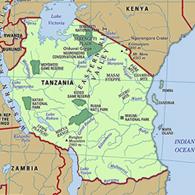
The United Republic of Tanzania was established in 1964 when the sovereign states of Zanzibar and Tanganyika united. Tanzania is 947,300 km2, which includes 54,337 km2 of inland water. The island of Pemba is roughly 984 km2 and the island of Zanzibar is 1,657 km2. One of the five countries in East Africa, Tanzania is located south of the equator.
Mainland Tanzania is situated between the area of Tanganyika, the Great Lakes of Victoria, Nyasa and the Indian Ocean. It boasts roughly 1,400 kilometers of coastline and is bordered by eight countries: Uganda, Burundi, Kenya, Rwanda, Zambia, Malawi, the Democratic Republic of the Congo and Mozambique. Due to six of these countries being landlocked, Tanzania provides natural access to the region.Between the years 2006 to 2014, Tanzania’s GDP grew at an average rate of 6.4%.
This growth record has been outstanding. It has ranked among the top 20 fastest-growing world economies and has been above the Sub-Saharan average of 5.2%The overall picture points to a prosperous future where the per capita income is growing at an average rate of 7%, thus raising the level of consumptive expenditure. The deficit balance of trade informs prospective investors that there is a huge potential to exploit and utilize available duty-free market opportunities in the European Union (EU), the United States of America and South Africa, to mention a few. For a period of 10 years, export value has grown by about 90% while imports recorded a growth of 70%. The headline inflation rate remained a single digit in 2014 and the first quarter of 2015. The inflation rate averaged 6.1% in 2014 compared to 7.9% in 2013.
.
Tanzania’s population is 51.82 million in as per National Bureau of Statistics 2014. Of the total population, around 97% live in mainland Tanzania and 2% live in Zanzibar. The population is growing at a rate of 3.2%, with the youth under the age of 15 years accounting for 45% According to the current population prospects of the United Nations, the population of Tanzania in the year 2050 will rise to 129,420,000 and, in the year 2100, to 275,620,000. The life expectancy in Tanzania is 61.4 years. Population by age 0–14 years: 45.00% 15–64 years: 52.00% Labour force (over 15 years): 25.28 mm (2014) Population growth: 3.2% (2014) Youth literacy rate (15–24 years): 86% (2012) Male: 87% (2012) Female: 85% (2012) Urban population: 31% (2014) English and Swahili are official languages. Religion: Christians, Muslims, and Indigenous beliefs. As per TIC, CIA, World Bank reports 2015.
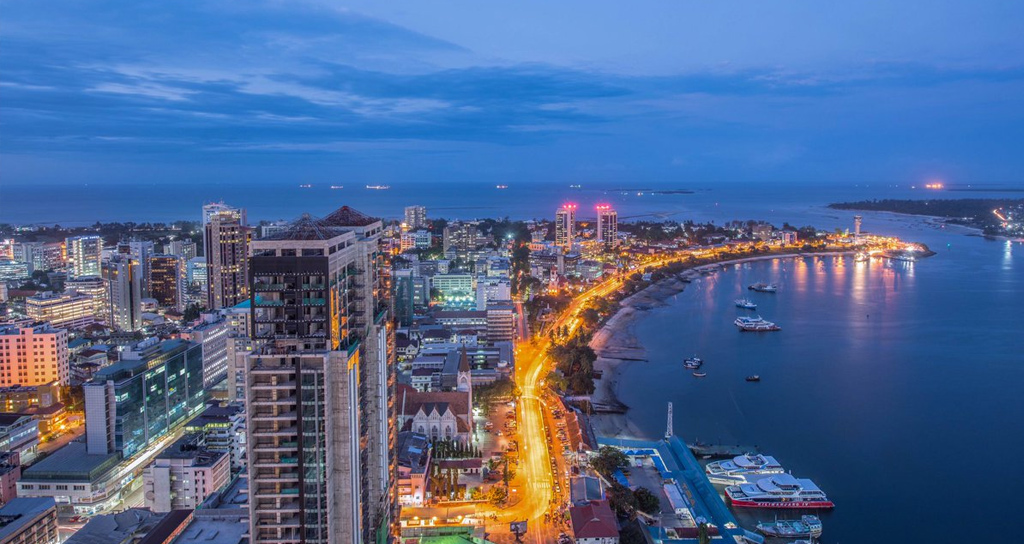
The country’s geography is greatly beneficial. Tanzania is connected directly to the Indian Ocean giving it trade links to Asia and sits in between the ocean and 6 landlocked countries (Uganda, DRC, Rwanda, Burundi, Zambia and Malawi) that rely on Tanzania for passage of goods. The country has 3 deep water ports (Dar es Salaam, Tanga and Mtwara) that are servicing the neighbouring countries. Furthermore, its membership to the SADC Free Trade Area and EAC Common Market, with developed rail and road networks, makes Tanzania a natural transportation gateway for East and Central Africa.
Apart from being a point for passage of goods, Tanzania’s internal production capabilities, driven by rich natural resources, e.g. large size arable land and mineral deposits make it a natural hub for economic activity in the East African Region.
Tanzania is a member of the Southern African Development Community (SADC) and the East African Community (EAC). Through EAC, Tanzania is a member of Tripartite Free Trade Area involving the Common Market for Eastern and Southern Africa (COMESA), SADC and EAC. This provides an enormous market opportunity targeting a population of over 600 million.
The EAC is an intergovernmental organization composed of the five republics: Rwanda, Kenya, Uganda, Burundi and the United Republic of Tanzania. The EAC was established in 1967, dissolved in 1977 and was re-established on 7 July 2000. Following negotiations with the Common Market for Eastern and Southern Africa (COMESA) and the Southern Africa Development Community (SADC) in 2008, the EAC approved an increased free trade area comprising all three organizations’ member states. EAC has a collective population of 145.5 million people, with a collective gross domestic product (GDP) of US$ 147.5 billion in 2015.
The EAC’s urban population is 19.26% and its urbanization rate averages 4.7%. Tanzania’s exports to the EAC over the years fluctuated between US$ 350 million and US$ 600 million as shown in table 3. There is more room to enhance exports within EAC and beyond. Currently, the regional market depends on imports from China and Far East countries to clothe its people. It’s safe to assume that a population of over 600 million people is a ready market for prospective investors, as it will be easier and cheaper to source clothing items regionally.
The Southern African Development Community (SADC) The SADC is an intergovernmental organization with headquarters in Gaborone, Botswana. Its aim is to advance socioeconomic integration and cooperation, along with security and political cooperation between 15 Southern African states. This is Free Trade Area with a population of over 300 million people and thus presents a huge opportunity for investors to market their products duty-free. Table 4 shows the performance of Tanzania in selling various commodities to SADC member states. An inadequate textile and garment manufacturing base in many SADC countries presents an opportunity to expand share of traded items within SADC from Tanzania, and investors will record trade growth year in, year out.
The country is eligible for the USA’s African Growth and Opportunity Act (AGOA), which offers duty-free exports to the USA from certain sectors, including textiles. The European Union’s (EU’s) Everything But Arms (EBA) initiative enables Tanzania to export some goods to the EU tariff-free. Tanzania’s special preferential tariff agreement with China allows it to export in excess of 400 products made in Tanzania to China tariff-free.
Given the economic and socio-political shift that has occurred in the domestic and international scene, The United Republic of Tanzania adopted a Foreign Policy focusing on economic diplomacy to secure the core national interest as a sovereign state. The Policy manifest itself in active international engagement, which is basically leveraged upon the pursuit of economic objectives, while at the same time preserving the gains of the past and consolidating the fundamental principles of Tanzania’s traditional foreign policy.
Tanzania is a rapidly growing emerging market, ranking among the 20th fastest growing economies in the world. The country has exhibited a GDP growth rate of around 7% for the past 5 years and it is predicted by the IMF and the World Bank to continue this rapid economic growth for at least the next decade. Over the last two decades the country has transformed itself from the centrally planned economy to a market oriented system through successful implementation of free market oriented reforms. These reforms have resulted in to positive growth trend and impressive macroeconomic indicators with inflation rates falling from 24.7% in 1995 to 5% in 2015. Recent discovery of massive natural gas reserves and increasing investment in manufacturing and agriculture is a positive sign of rapid advancement of the economy. Establishment of the PPP framework in the country ensures private sector participation in provision of public goods and services, in particular public infrastructure.
Tanzania is politically stable and has enjoyed political stability since independence in 1961. It is one of a few African countries with a stable and peaceful socio-political environment. The country remains free of ethnic and religious tensions and the violence that has struck so many developing countries. The country has ushered in political pluralism, increase democratization as part of global political reforms. Specifically, in 1992, the country officially adopted the multiparty system and, in 1995, the first multiparty general elections were held.
These political developments, particularly the pluralistic political environment, have ushered in a new era and heightened the level of democratization-there is more freedom of speech, movement, and increased participation in the decision-making process. The country, has since 1992 held the fifth Multiparty general election in 2015 in a peacefully manner in which more than five political parties participated in the electoral process. Political stability has given Tanzania a peace dividend that continue to lay foundation for the strong economic performance.
The Tanzanian legal system is based on the English Common Law system. The first source of law is the Constitution of 1977 followed by statutes or acts of parliament; and case law, which are reported or unreported cases from the High Courts and Courts of Appeal and are used as precedents to guide the lower courts. The Court of Appeal of Tanzania, which handles all the appeals from Mainland Tanzania and Zanzibar, is the highest ranking court in the country, followed by the High Court of Tanzania, which handles all types of civil and criminal cases and commercial matters.
There are four specialized divisions within the High Courts: Labor, Land, Commercial, and Corruption and Economic Crimes. The Labor, Land, and Corruption and Economic Crimes divisions have exclusive jurisdiction over their respective matters, while the Commercial division is without exclusive jurisdiction. District and Resident Magistrate Courts also have original jurisdiction in commercial cases involving monetary amounts up to TZS 50 million ($22,442), and TZS 300 million ($134,650), respectively. The High Court has original jurisdiction for cases exceeding that amount.
Apart from the formal systems of courts, there exist quasi-judicial bodies including the Tax Revenue Appeals Tribunal, which was established under the Tax Appeals Act, and the Fair Competition Tribunal, which was established under the Fair Competition Act. Notwithstanding the court and quasi-judicial bodies, Tanzania also has alternate dispute resolution procedures in the form of arbitration proceedings.
Judgments originating from countries whose courts are recognized under the Reciprocal Enforcement of Foreign Judgments Act (REFJA) are enforceable in Tanzania. To enforce a foreign judgment from a court in a listed country, the judgment holder has to make an application to the High Court of Tanzania to have the judgment registered. Countries currently listed in the REFJA include Botswana, Lesotho, Mauritius, Zambia, Seychelles, Somalia, Zimbabwe, Swaziland, the United Kingdom, and Sri Lanka.
The electricity supply industry in Tanzania is currently dominated by the Tanzania Electric Supply Company Limited (TANESCO), which is a vertically integrated state owned company. TANESCO owns and carries out generation, transmission and distribution of electricity up to the final consumers, and sells electricity in bulk to Zanzibar Electric Company (ZECO) through submarine cables to Zanzibar and Pemba Islands. On the generation side there are other players which include Independent Power Producers (IPPs), Small Power Producers (SPPs) and Emergency Power Producers (EPPs). As of June 2016, the installed capacity in the Isolated Grid was 84 MW, while installed capacity in the Main Grid was 1,358 MW. The Maximum Demand attained was 1026 MW, recorded on 15th March 2016. During the 205/16 period a total of 6,449 GWh were available for sale which implies a 2.9% increase as compared to 6,262 GWh reported during the previous year. These units were received from TANESCO plants, IPPs, SPPs and imports from neighboring countries.
Under the Tanzania Investment Act of 1997 and the Land Act of 1999, occupation of land by non-citizen investors is restricted to lands for investment purposes. Land may be leased for up to 99 years, but the law does not allow individual Tanzanians to sell land to foreigners. There are a number of opportunities for foreigners to lease land, including through TIC, which has designated specific plots of land (a land bank) to be made available to foreign investors.
Foreign investors may also enter into joint ventures with Tanzanians, in which case the Tanzanian provides the use of the land (but retains ownership, i.e., the leasehold). The URT is currently expanding TIC's land bank, through an established land bank compensation fund, and modernize its land titling and registration system.
The Fair Competition Commission (FCC) is responsive to requests for assistance from private companies and takes action against counterfeiters.
Registration of patents and trademarks is on a first-in-time, first-in-right basis, so companies should consider applying for trademark and patent protection in a quick manner. It is the responsibility of the rights' holders to register, protect, and enforce their rights where relevant, retaining their own counsel and advisors.
Under the Capital Markets and Securities (Foreign Investors) Regulation 2014, there is no aggregate value limitation on foreign ownership of listed non-government securities. Only foreign individuals or companies from the other East Africa Community (EAC) nations (Burundi, Kenya, Rwanda, South Sudan, and Uganda) are permitted to participate in the government securities market. Telecoms companies in Tanzania are obliged to float a 25 percent stake on the DSE; whilst as part of mining (Minimum Shareholding and Public Offering) Regulations 2016, large scale mining operators are required to float a 30 percent stake on the DSE. Many investors have secured credits on the local market.
IMF reported in its January 2017 Fifth Review under the Policy Support Instrument that the “banking sector is well-capitalized, liquid and profitable on average.” On March 6, 2017, the Bank of Tanzania (BoT) decreased the interest rate which it charges for lending to other banks from 16 percent to 12 percent to increase access to credit for the private sector. Private sector companies have access to a variety of commercial credit instruments including documentary credits (letters of credit), overdrafts, term loans, and guarantees. As of June 30, 2016, the banking sector was composed of 41 full-fledged commercial banks, 3 financial institutions, 12 community banks, 4 deposit taking microfinance banks, 3 financial leasing companies, and 2 private credit reference bureaus. Financial inclusion is dramatically increased contributed to successfulness of mobile banking. Credit Info Tanzania Limited and Dun & Bradstreet Credit Bureau Tanzania Limited are only two private credit bureaus operating in Tanzania.
Tanzanian regulations permit unconditional transfers through any authorized bank in freely convertible currency of net profits, repayment of foreign loans, royalties, fees charged for foreign technology, and remittance of proceeds. The only official limit on transfers of foreign currency is on cash carried by individuals traveling abroad, which cannot exceed $10,000 over a period of 40 days.
The URT developed and is implementing a skills development framework to make sure Tanzanian are gaining the necessary labour skills to create the industrialized economy. The FYDP II recognizes the need for graduates to possess more marketable skills and for students to have better learning environments. As the number of university graduates is increasing, this skills programme will position investors with sufficient workforce to fill various positions.
In Tanzania, labor and immigration regulations permit foreign investors to recruit up to five expatriates when these skills are unavailable locally. The 2015 Non-Citizens (Employment Regulation) Act requires employers to submit “succession plans” for their foreign employees, detailing how knowledge and skills would be transferred to local employees. Under the new law, non-citizens may be granted work permits for a period of two years which may be renewed up to a total validity period of five years.
Mainland Tanzania's minimum wage is set by categories covering 12 employment sectors. The minimum wage ranges from Tsh 100,000 ($45) per month for agricultural labourers to Tsh 400,000 ($180) per month for laborer’s employed in the mineral sector (companies with mining and prospecting licenses).
The Government implements a compliance program whereby company management/individuals seeking government tenders shall abide to and are required to submit a written commitment to uphold anti-bribery policies. Giving or receiving a bribe is a criminal offense in Tanzania. Enforcement of laws, regulations, and penalties to combat corruption continued to be voiced by President Magufuli, who took office in November 2015, this has affected public discourse about the prevailing climate of impunity, and some officials are reportedly more reluctant to engage openly in corruption.